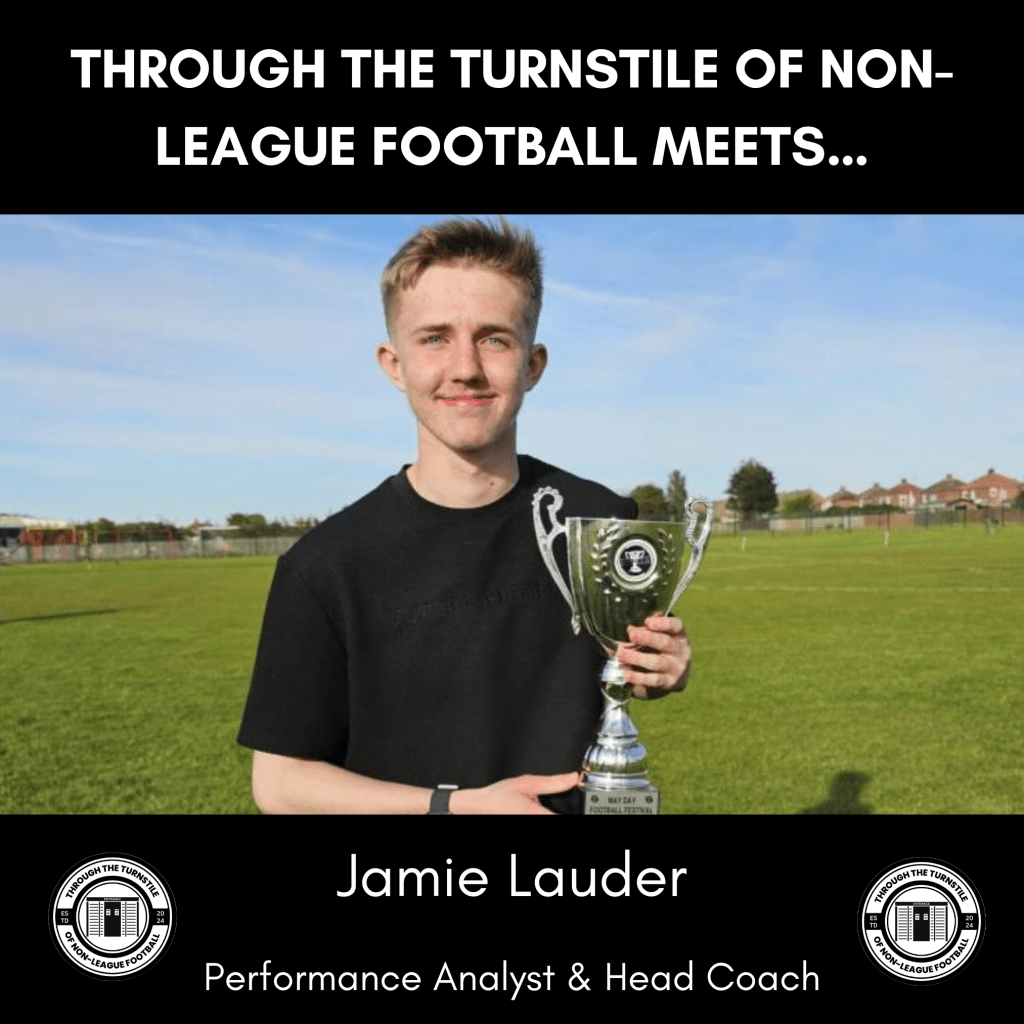
Welcome back everyone! This time we sit down and speak to an up and coming football coach/analyst Jamie who is making serious inroads in the footballing world in his current role at Darlington FC.
So let’s get into it!
Name – Jamie Lauder
Age – 17
Favourite Team – Norwich City
Occupation – Football Coach/Analyst
One thing I love about football is – Last minute limbs
Football pet hate – Tiny shin pads!!
Q) Can you explain your role as a non-league football analyst and what a typical day looks like for you?
For me, a typical day will vary, depending on if we’re training, doing pre-session analysis or if it’s gameday. I balance analysis and coaching with my studies, so if we’ve not got a session I’ll usually be working on an opposition analysis report for a game coming up. We post all of our opposition analysis early in the week, if we’re playing on Saturday, so I’ll start watching footage, or looking at stats probably 10/11 days before whichever game we’re preparing for.
Q) What motivated you to focus on non-league football analysis, and how does it differ from working in the professional leagues?
I’m lucky enough to live near a few National League North teams, so when making the decision to go into analysis, it was a no-brainer to try and observe the coaches and players at a really high level of the non-league pyramid. Last season, I was working for Spennymoor Town under some unbelievable coaches and people, and it’s exactly the same at Darlington. Step 2 is full of top footballing people, and it’s always a great experience to help them prepare, and watch them deliver.
Q) What kind of data and metrics do you focus on when analyzing non-league football matches? How do they compare to the stats used at higher levels?
They’re really similar. We use Wyscout, a platform used by pretty much every professional club in the country, to dive into any stats for any player, depending on position, or what we’re wanting to look at.
We also use Wyscout for whole-team stats to further assess performance, such as xG, touches in opp box, passes into final 3rd%.

Q) How do you balance traditional match-watching with data-driven analysis when assessing a team’s or player’s performance?
Traditional match-watching will always be more important. Stats can be manipulated or misinterpreted, but actually watching a match gives you a much better insight into how a team’s going to play or how an individual is performing.
Though, data’s incredibly important to support or challenge those opinions. Statistics alter the way you view performance and you become more conscious of where you might be underperforming.
Q) What are the key performance indicators (KPIs) you prioritize when analyzing non-league football teams, and why are they important?
The KPI’s for me would be running figures. How far a player’s running in relation to their position, how far they’re sprinting and how often they’re sprinting. It’s often more important to analyse intensity than distance ran. Making sure that players are aware of their running levels helps drive good practice, and helps coaches deliver accurate feedback.
The other KPIs would be entirely around a coaching staff’s tactical approach, and which parts of play are important for how they’d like to play.

Q) How do you gather and process data from non-league games, especially given the limited resources and technology available compared to professional leagues?
Like I said, Wyscout is an incredible platform full of data and clips for every team and player in our league. This makes gathering the data really easy, the difficult bit is interpreting that data to form accurate opinions that will be useful to the players and coaches.
Q) What are some of the unique challenges you face when analyzing non-league football, and how do you overcome them?
One of the major challenges is how little time we get with the players, compared to professional set ups. When we’re training 2 nights a week for a few hours, it becomes incredibly difficult to do pre/post-match analysis. This means a lot of the onus is on the players to go away and rewatch the games, and watch all of our analysis videos in their own time. If players are working a 9-5, this can be really difficult to keep on top of.
Q) How do you communicate your insights and analysis to coaches, managers, and players in non-league football?
We use a platform called Hudl to upload all of our analysis videos. All players and coaches have access to the site, making it really easy for them to dive into all of our games, sometimes opposition games and opposition analysis.
For other things, we’ll just communicate with players or management over message.
Q) Can you share an example of how your analysis has directly impacted a non-league team’s performance or strategy?
I think for every game, our analysis plays a big role in what our game plan will be or how we’ll look to exploit parts of the opposition. Whether that’s noticing set-piece trends, or individual player weaknesses, analysis is a big part of what we do at Darlington.

Q) Non-league clubs often operate on smaller budgets and resources. How does this affect the use of data and analysis in their overall strategy?
We obviously operate differently to a lot of bigger clubs, and definitely full time clubs. For us as analysts, we have to manage making an opposition report, or two, a week as well as having a separate job. Sometimes you’re watching most of 3 or 4 games to make sure your assessments are correct, so it can be really difficult compared to full-time analysts who have time to do that on the day-to-day.
In terms of our platforms and software that we use – Hudl and GPS analysis – there isn’t a big difference between us and EFL clubs.
Q) In what ways do you see non-league football analysis evolving in the future, especially with the growing influence of technology and data science?
Non-league football is evolving all of the time. Some National League clubs have 10+ scouts watching matches across the country, on top of having recruitment analysts. As analysis becomes a more vital part of football at the top level, and within the EFL, clubs will always be looking to gain an advantage.
Q) What role does video analysis play in your work, and how do you handle the practicalities of obtaining footage in non-league football?
Video analysis is as easy for us, at Step 2, as it is for any club higher than us in the pyramid. All teams in our league take part in a video exchange, so we have to post the full match footage of every game. All of those games are Wyscout, which lets us watch every event from those games. The site profiles each individual player’s clips and team events, making it really easy for us to find useful videos.
Q) How do you identify talent at the non-league level, and what key factors do you look for that might indicate a player can step up to higher leagues?
There’s not too much difference to identifying talent at our level than there is further up the pyramid. Most of our recruitment is done by watching the players live, or watching clips on WyScout. Like at any level, there may always be hidden gains to be made – like using a player’s xG or xA to determine undervalued players, but generally if a player looks the part when we watch him, we’ll look to pursue the signing.

Q) How important do you think data analysis is in terms of helping non-league clubs compete and succeed, especially against more financially strong teams?
Data analysis can be incredibly important to supplement game plans, and provide substance to visual opinions. It’s really important to get the balance right with what info you give to the players, but for coaches looking to gain an advantage, having a level of analysis is certainly more important than not.
Q) What advice would you give to aspiring analysts who want to work in non-league football, considering the challenges and opportunities that come with the role?
My advice would be to just offer your services to clubs! Reach out to clubs (at any level of the pyramid) and offer to record their games and complete analysis – even just tallying statistics throughout a game, and most coaches will want you down. Alternatively, offer your services to a club that already has an analyst, and reach out to the analyst. If you can shadow, or even just play a small role, you’ll be able to take so much on board and learn.
———————————————————————————————————————
A massive thank you to Jamie for giving up his time and showcasing some of the work that he as an analyst carries out and also outlines what you could do to get into the industry and role of a analyst.
People like Jamie really do just showcase what can be achieved once you know what you want and just go for it, passion and determination are the keys to unlock most doors in life. Go get it!
AND before I let you all go – the voting for the content awards closes on the 13th October and I would be extremely grateful if you could follow the link: https://footballcontentawards.com/voting/ and vote for ‘Through the Turnstile of Non-league Football’ in the Best in Non-league editorial category.

Until next time!

 Through The Turnstile of Non-League Football
Leave a comment