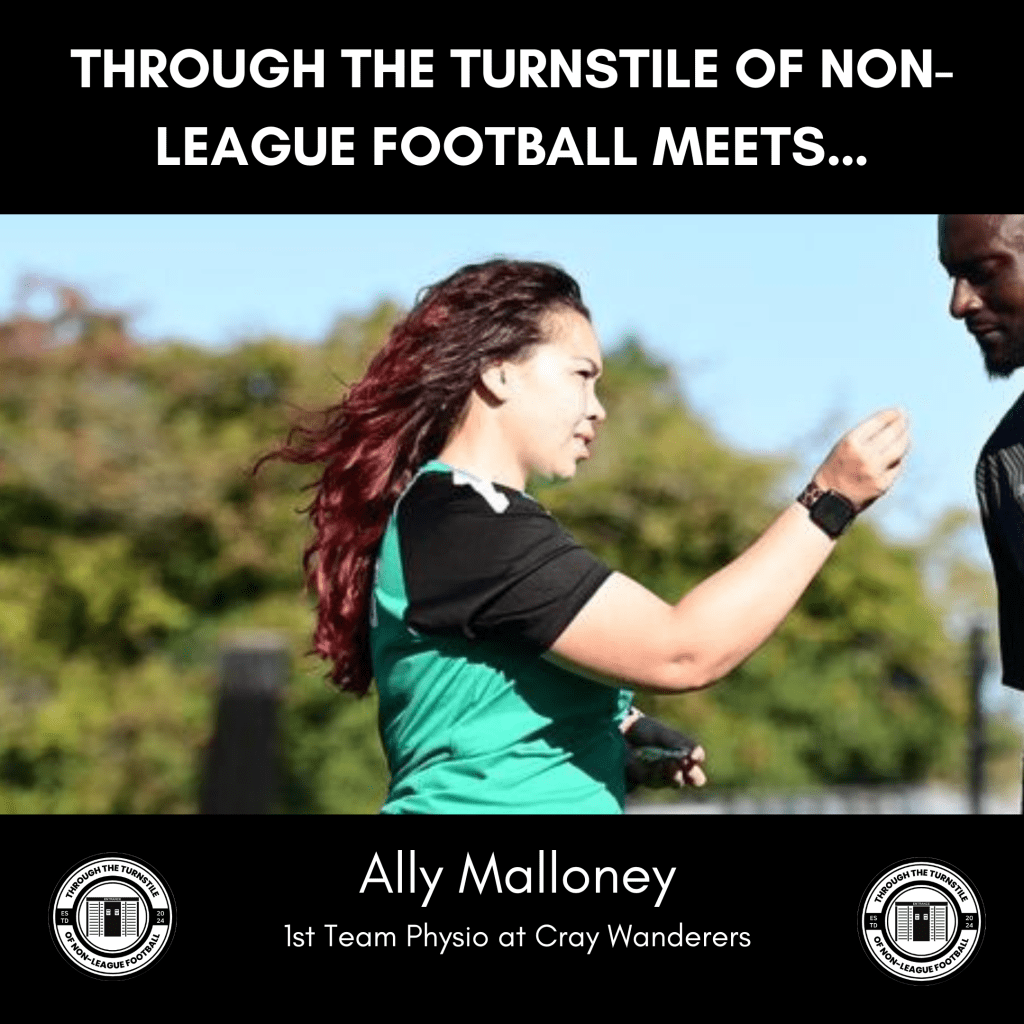
Welcome back to another TTTONLF meets as this time we sit down with Cray Wanderers 1st team Physio Ally Malloney.
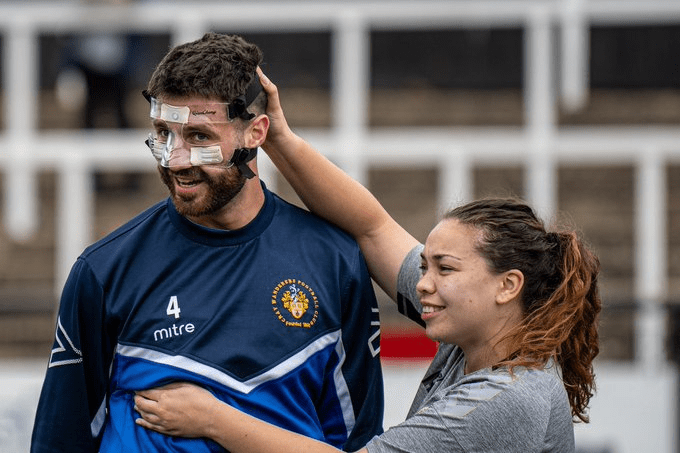
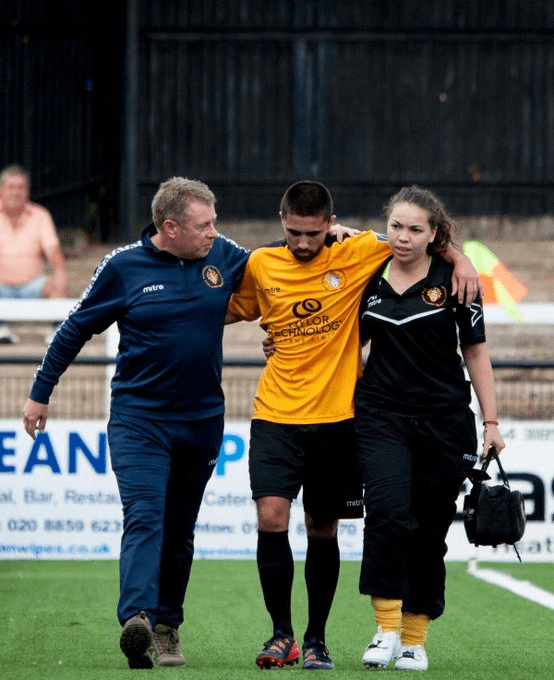
One of the most important staff members of the backroom staff on every team at all levels, simply because they are responsible for keeping the team healthy and fit. Not only that but they are the key staff members who can help to prevent injuries occurring in the first place by providing the management team with unbiased opinions on a players health and conditioning before they take to the pitch.
I am excited to find out more about the life of a physio and how someone like Ally has come into the role she now finds herself, lets get stuck in and find out!
Name – Ally Malloney
Age – 37
Favourite team – West Ham United (though I always keep an eye on my old non-league clubs too –
once you’re part of them, you never really stop being part of them!)
Thing I love – It’s all about the connections for me. Whether it’s the buzz in the changing room after a win or someone stopping me in the bakery aisle at Morrisons because they’ve spotted my training kit and want to chat about how nice the new ground is—it’s that sense of community that makes it so special.
Pet hate – When the lads sneak into my physio bag without me noticing. Honestly, trying to track down my scissors before kick-off is like Mission Impossible.
Q) What is your background in sports science?
I come from a straight physiotherapy background. I graduated from UEL back in 2009 (pre-Westfield Stratford!), which makes me feel ancient! I kind of fell into sport by a bit of luck, but once I was in, I was hooked. I’ve always been passionate about football, so I threw myself into learning and growing as a physio in the non-league world. Sixteen years later, I’m still here, still loving it, and still chasing down lads for nicking my tape!
Q) Did you always want to work in football?
The short answer? Yeah, absolutely. It’s actually a big part of why I went into physiotherapy in the first place. I grew up in a football-obsessed household and used to go to West Ham with my uncle. Being at Upton Park, that old-school atmosphere, hearing the players shout, seeing the game unfold right in front of you—it made the game feel so alive, so physical and real. That lit a spark in me. I knew I wasn’t going to make it as a player (that was more my brothers’ thing), but I still wanted to be part of it somehow. Physiotherapy became my way in, and I’ve been lucky enough to carve out a little space for myself in the non-league world.
Q) Was it always as a physio or did other elements of the sporting world appeal to you?
Like I mentioned earlier, I did give playing a go—but I’ll be honest, I wasn’t very good. Once I accepted I wasn’t going to be the next Beckham, I had to start thinking about an actual career. I was about 14, I think, and for a while, I was convinced I was going to be an archaeologist. I’d clearly watched too much Indiana Jones and Jurassic Park—very impressionable child!
Around that time, my grandfather had a stroke while he was back home in St Lucia. When he returned, I was amazed to see how mobile he was—he could walk and use his arm again. I was full of questions, and he told me all about the rehab and the physiotherapists who helped him.
That was it—I marched myself down to the careers library (this was pre-ChatGPT, sadly!) and started digging into what physio actually was. And boom—there it was. A career that mixed football, science, and care. It ticked all the boxes. That led me into the NHS, and honestly, I’ve never looked back. I might not be wrangling dinosaurs or rocking a fedora while dodging snakes (which, to be fair, I wouldn’t cope well with anyway), but I’ve ended up in a job that’s pretty exciting in its own right.
Q) What has your journey into becoming a football physio been like for you?
Once I started my degree, I was lucky enough to be mentored by a non-league physio named Alex Gallego. He’d been treating my brother for an injury, and he kindly took me under his wing. I think he saw that early spark in me—that mix of interest and passion just starting to show. He really helped turn that spark into something stronger. I owe a lot to Alex.
I shadowed him down at Cray Valley PM and Charlton Vets, and once he felt I was ready, he sent me off to look after my own team. That was Greenwich Borough—sadly, the club doesn’t exist anymore, but it was the start of everything for me. From there, I built up my skills and reputation, drawing on those early lessons from Alex, and continued my journey through clubs like Fisher, SE Dons, and Cray Wanderers.
I also owe a lot to my parents—especially my dad. He’d drive me to games, come with me to meet managers for the first time, and sit with me after matches to talk things through. That kind of support gave me the confidence to keep pushing forward, even when things felt a bit daunting. Both he and my mum still come to Cray games now, and honestly, having them in the stands means the world to me. It’s hard to not be motivated when I am supported so much by those around me.
It hasn’t always been easy—non-league isn’t exactly glamorous—but it’s been 100% worth it. Alex passed away over ten years ago now, but I carry a lot of what he taught me into my work, and I try to honour his memory in the way I look after the people around me. I hope I have made him proud.
Q) How did you come into your role at Cray Wanderers?
Cray Wanderers is one of those legendary-status football clubs, isn’t it? I remember looking up from the Kent League and thinking they were in a different world. So when the opportunity came to move across with Tony Russell and the squad from VCD Athletic, I didn’t fully realise what a turning point it would be for me. I didn’t know then that I was about to find my place—my people, my club.
I spent a good few years at Cray before stepping away during the Covid season. I had a little sabbatical over in East London with Barking, but eventually, the time came to come home.
I’ve got Anthony Cook—Cookie—to thank for helping me find my way back. He connected me with Neil Smith after I’d left Barking, just as the physio role at Cray had opened up. I still remember Smudger sitting in my parents’ front room, chatting with me about coming back and the vision for the club, especially with the new ground on the horizon. And just like that, I was back—wandering no more.
These days, I’m loving working alongside Tosh, Alfie, Ugo, Paddy—all the lads—as well as the amazing staff and volunteers behind the scenes. I really valued my time working with Smudger before he moved on to an incredible opportunity with Crawley. I feel incredibly lucky to be part of a club like this.
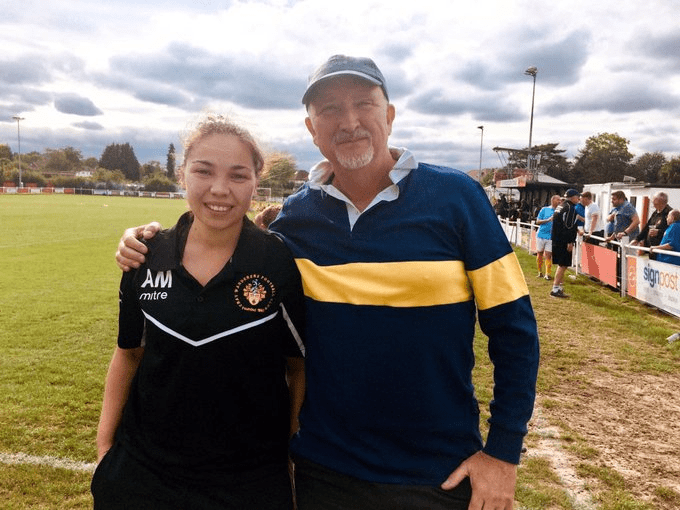
Q) What has your time been like at club?
If I didn’t have such a strong connection to Cray, I wouldn’t have come back—it’s as simple as that. Cray’s always been part of my life. My dad managed my brother’s team when he played for Cray Youth, so it’s always felt familiar. And as a physio, I’ve kind of come of age with Cray Wanderers. I’ve had the highs—winning titles—and the lows, like tough play-off losses. Honestly, it’s been a real journey.
There are so many people at this club who feel like family now. From Bill Lappage, our legendary goalkeeping coach, to Gary the chairman, to fans like Martyn and Mark—and so many others—they’ve all shown me so much support over the years. I genuinely couldn’t feel more at home if I tried.
During Covid, when things were really tough for me as a healthcare worker, it was this club that kept me grounded. I kept a little squad picture in my locker at work, and seeing it every day reminded me that the world was still out there waiting for me. That sense of belonging got me through some dark times.
Q) What is it that you enjoy so much in your role?
I know it’s a bit of a Miss Universe answer, but honestly—it’s the connection with people. I love helping others. I love hearing their stories, their problems, and figuring out how to solve them. There’s something really special about building those human relationships and then watching my lads thrive—seeing them come through injuries, build confidence, and get back to doing what they love. I love football. I love football people. How could I not enjoy being pitchside every weekend? Even watching training brings me joy. Footballers are at their happiest when they’re playing—and I’m at my happiest when they’re happy.
Q) What is the biggest challenge for you?
My height! No, but seriously—I’d say the biggest challenge has been pushing through my own self-doubt. I’m naturally quite introverted and have struggled with confidence at times. Changing rooms can be loud, busy, and full of big personalities—it’s easy to feel a bit lost in that environment. But over time, I’ve learned to hold my own space in my own way. It’s been a real confidence-building journey.
And look, I’ll be honest—navigating a changing room full of half-dressed footballers has its own challenges! You definitely learn the art of the well-timed exit or perfecting your “eyes on the ceiling” technique early in your career. But it’s all part of the job, and you adapt pretty quickly.
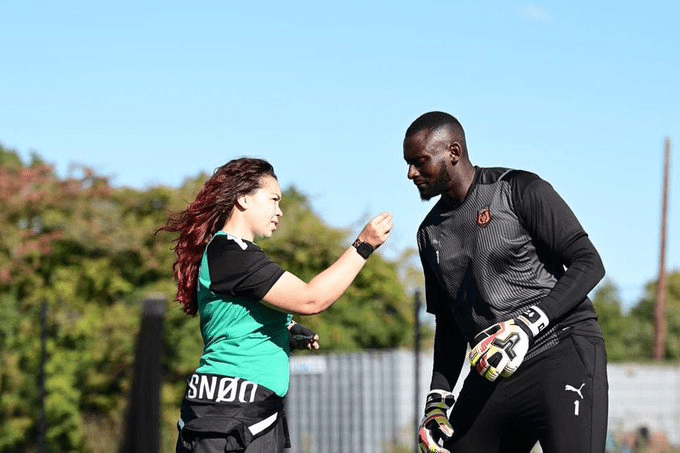
Q) What is it like being involved in the growing Non-League football scene?
That’s actually quite a hard one to answer, because I’ve always been around non-league football—so in some ways, it feels the same. But there’s definitely been a shift. It’s brilliant to see non-league getting the recognition it deserves. The crowds are growing, the support is stronger, and the whole movement is building momentum—and that can only be a good thing.
I’m just a small part of that journey, but I’m really proud to be involved. Non-league football has such heart, and I honestly believe it’s only going to keep growing. I’m excited to see what the future holds.
Q) Is it difficult for you being a woman in a male dominated industry?
This perception is always interesting to me, because Physiotherapy itself is actually a female-dominated profession. It’s really only in sport that the switch happens—and even that’s changing. Over my 16-odd years in the game, I’ve seen a big rise in the number of women working in football. Maybe having people like me around has helped show it’s possible, or maybe it would’ve happened anyway—but either way, it’s a positive shift. Of course, there are still challenges. I’d love to say I’ve never lost out on an opportunity because I’m a woman—but I probably have. That’s just the reality for many of us. But I try to focus on the opportunities I have been given.
The managers who trusted me, backed me, and gave me the space to grow—I’ll always be grateful for that. The roles I didn’t get? Maybe they weren’t right for me anyway. Maybe missing out is what helped me find my way into non-league football, to a place where I was wanted and valued. Hopefully, I’m repaying that faith now. There have been tough moments—things I wouldn’t want anyone else to have to deal with—but I’ve chosen to stay, to push forward, and to be visible. I want to showcase the positives of this profession, not be pushed out by negativity.
Sometimes you do have to adapt and rise above certain behaviours, but I always let my work speak for itself. I won’t let those moments define me. Women in football are no longer a rarity. We’re becoming the norm. And those prehistoric attitudes? I genuinely believe they’re heading the way of the dinosaurs. Which, ironically, makes all those childhood hours watching Jurassic Park feel slightly more relevant than I ever expected.
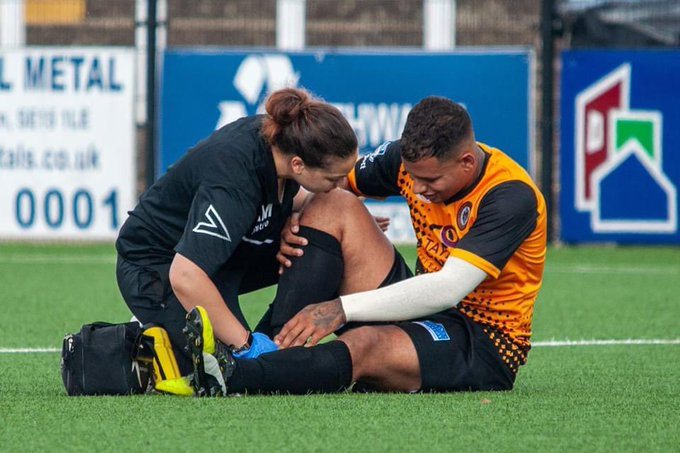
Q) What would you say to someone looking to become a physio themselves?
Do it. Honestly—it’s been the making of me. Who would’ve thought a little South London girl like me could end up doing all this? If I can do it, they absolutely can too.
I do quite a bit of mentoring and student work now, and I’ve recently started speaking at universities about my career. So I’ll share the advice I give to those students:
1.Get experience. Reach out to physios at local clubs, shadow where you can, watch sessions on YouTube, email clinics, connect with people on social media—however you do it, just find a way to get a feel for the role and see if you catch the physio bug.
2.Be creative. There are loads of routes into sports health and physio work. Whether it’s strength and conditioning, rehab, or even performance science—there are lots of ways to be part of the sporting world.
3.Be prepared. It’s a tough course. There’s a lot of theory, placements, and long hours—but the end result is so worth it. I mean, I’m a bit biased… but it’s honestly one of the most rewarding careers out there.
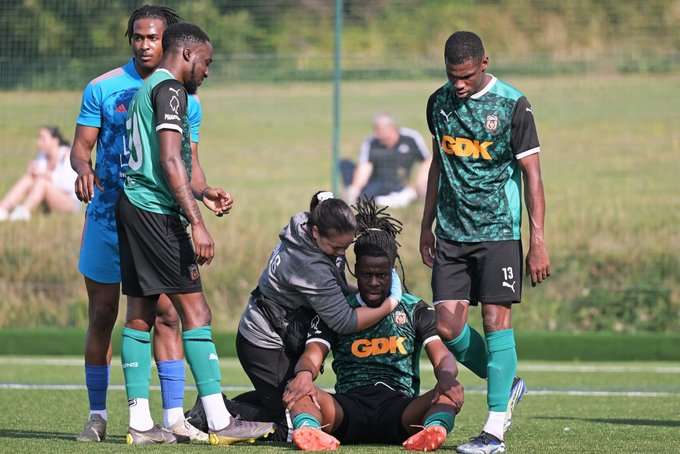
Q) What is your plan for the next 5-10 years?
If I’m being brutally honest—I’m not entirely sure! I’ve got one more year left on my pitchside registration, and then it’s decision time: do I renew for another three years or start to wind things down a little? Either way, I feel like I’ve had a pretty good innings.
That said… I would love to have just one game at Wembley. Maybe that’s what I’m quietly holding out for.
Lately, I’ve really felt the pull to support the next generation coming through. I want to help young physios find their feet, understand their value, and see what a brilliant opportunity non-league football can offer. That’s why I’m helping set up the Non-League Therapist Support Network alongside a few other brilliant therapists. I’ll be leading on the mentoring and learning platforms, and I’m genuinely excited to see that take shape in the close season.
I’ve always taken life one season at a time—and to be honest, I’m just as curious as anyone to see what I get up to next!
————————————————————————–
Thanks to Ally for the level of detail in her answers, I was fascinated to hear some of the answers and the overall journey which she has personally taken to be where she is today.
I think Ally’s story just highlights how special Non-League Football is, anybody who is reading this and is looking to get involved in football in some capacity whether that be as a Physio or other roles, i point you to what Ally said:
“Do it. Honestly—it’s been the making of me. Who would’ve thought a little South London girl like me could end up doing all this? If I can do it, they absolutely can too.”
DO IT! Reach out to clubs you want to work with and start by asking questions and volunteering some time, once you have your foot in the door you can start to build up your role and responsibilities from there.
Finally – thanks Ally, I was a massive fan of the Jurassic Park references!
Until next time!
———————————————————————————————-
Parks to Pitches (1st & 2nd edition) – a dedicated Non-league magazine brought to you by Through the Turnstile of Non-League Football!
£3 each!
Grab your copy here: https://tttonlf.square.site/


 Through The Turnstile of Non-League Football
Leave a comment