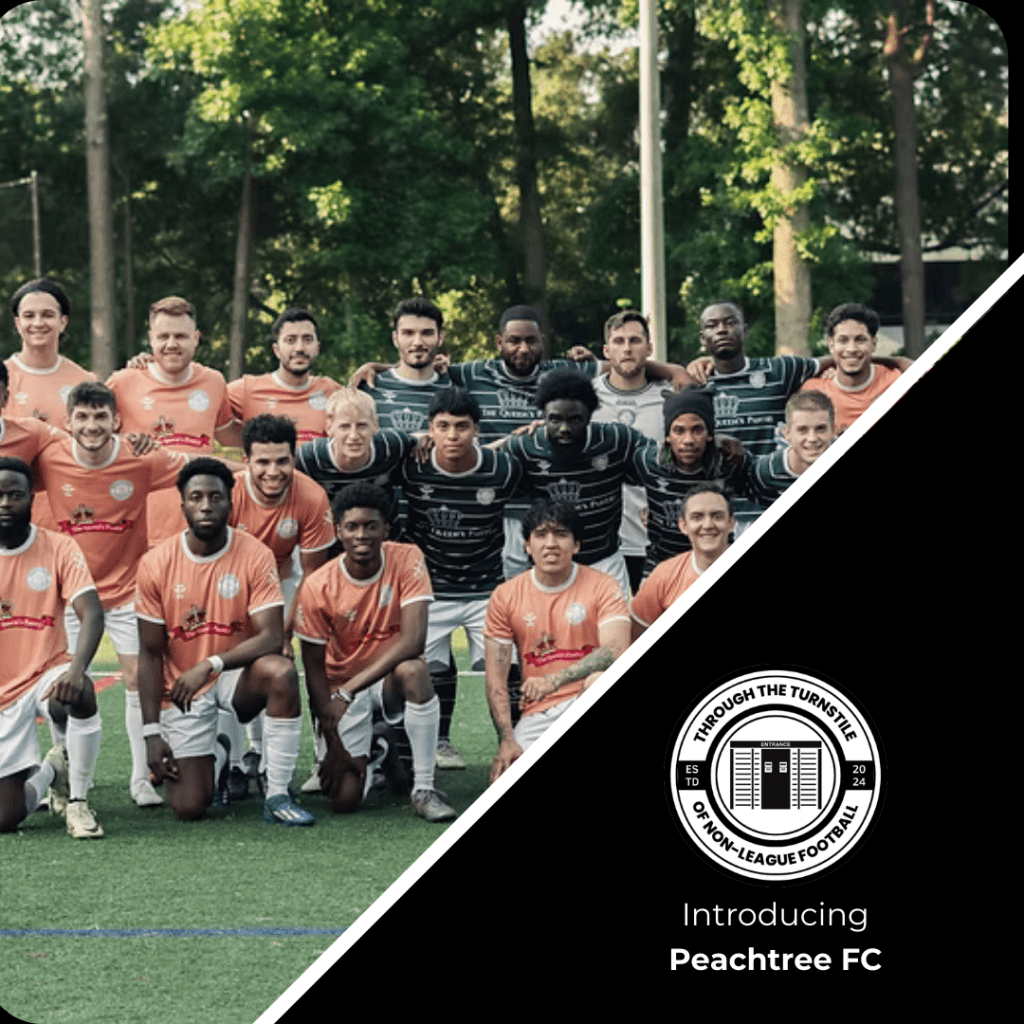
The year is 2026 now as you are aware (I hope) and that means the 2026 World Cup is just around the corner, taking place across Canada, Mexico and predominantly the USA. I therefore thought there was no better time than now to introduce you to a grassroots club in America who are really making a statement, drawing a professional inspiration from the UK in the way in which it operates day to day, especially on a match day.
I sat down with the man behind this club, Jon, who has some great plans for the future, I will let him tell you in his own words. I am certain you will be very impressed.
Name – Jon Sutton
Age – 30
Favourite team – Liverpool
Occupation – Operations Director of Menswear
Thing I love about football – the passion and the global connections
My football pet hate – half and half scarves
Q) Born in the UK and moving to the US aged 7 years old, was you always a fan of football from a young age?
I was! From watching Coventry City games as a baby to watching Liverpool preseason games in the US to trips to Anfield and watching games on TV at all levels, I’ve been a fan of the sport my whole life.
Q) When did you start playing Football and was that easy to continue when you moved to the America?
I’ve been playing as far back as I can remember including time in England. When I first moved to America I did try American sports like baseball to help integrate into American culture, but eventually got back into football when I was 12. It’s definitely more difficult in the states due to the pay-to-play model which can be prohibitive for everyone who loves the sport to play it.
Q) In America the landscape is quite different for sports as a whole due to the scale of the likes of the NFL, NBA and MLB, the MLS and ‘soccer’ is very much playing catch-up, how does that affect the grassroots level of the game?
I think the youth game in particular is where it’s still clear that soccer is playing catch-up. Most people will tell you they played soccer when they were 4 but then moved into another sport once they were older. If soccer was competing against fewer sports then I think the US would develop more players into world-class players as well as ultimately benefiting the grassroots level with higher quality players.
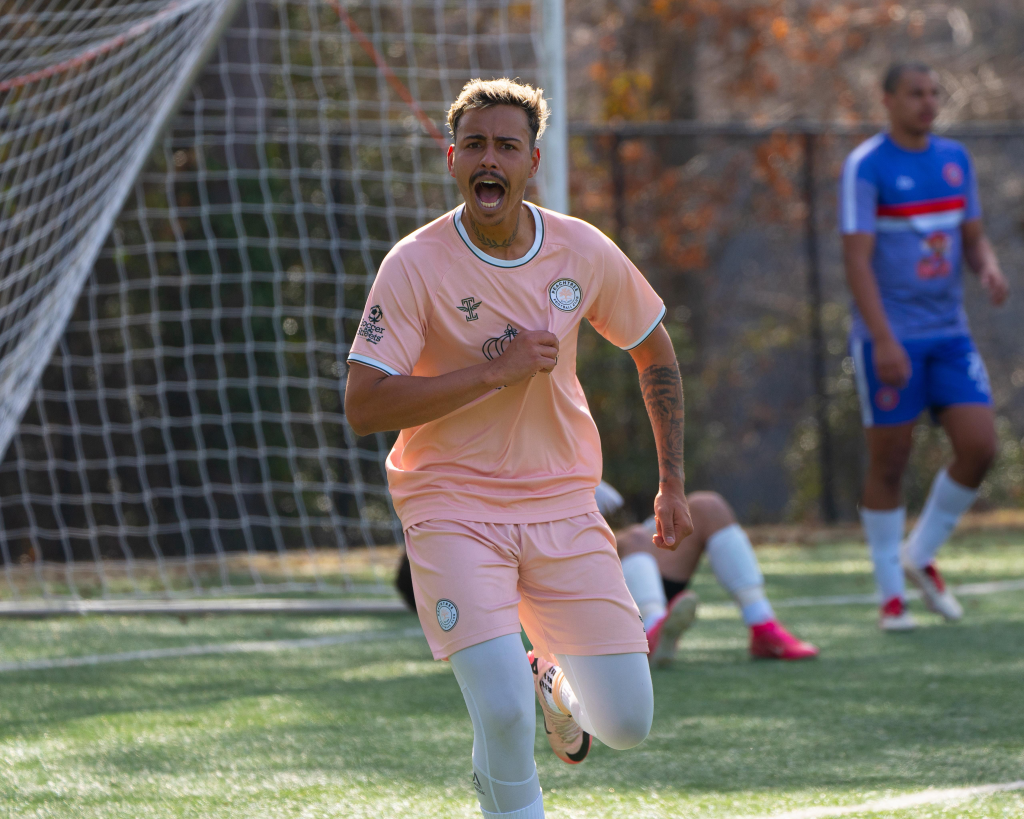
Q) How accessible would you say the game is for an American citizen right now?
I think playing is highly inaccessible due to the pay-to-play model. With no promotion/relegation and the segmentation of youth versus adult clubs where there is little benefit to developing a player to earn a large money move elsewhere or to earn more revenue by rising up the pyramid, teams don’t invest as heavily and have to rely on funds typically from players at the amateur or youth level. This means that players are
Q) First utilising the amazing work that ‘Soccer in the streets’ do for yourself and now working alongside them, would you say that this was a real driving factor in launching Peachtree FC?
The club definitely wouldn’t exist without all the amazing work that Soccer in the Streets does. The team started as a 5-a-side team at the Lindbergh field of StationSoccer made up of players I met playing pickup and with some of those guys still on the team, it’s grown into the 60 player club with two teams that we have now.
Q) You wanted to offer the people in your local area of Atlanta a place to call home for those that love football, tell us about the birth of your club Peachtree FC.
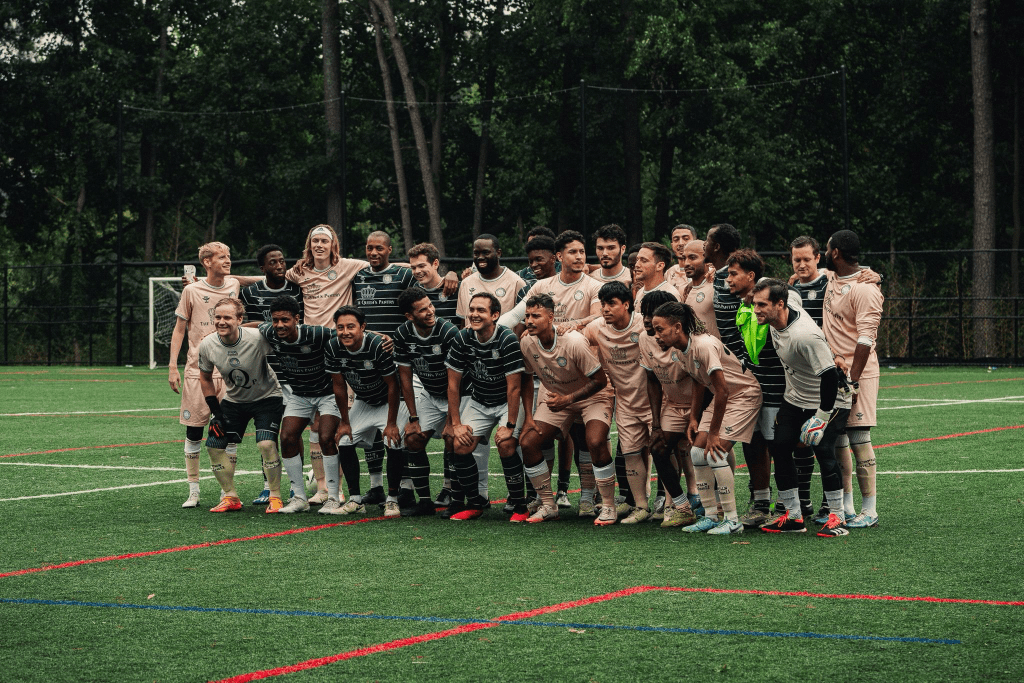
I moved back to Atlanta in 2020 and wanted to continue playing soccer after having a great experience playing in New York City for New York International FC. I struggled to find a team that had similar professional standards at an amateur club and having been part of the 5-a-side StationSoccer team with growing interest, I decided to pursue the goal of starting my own 11-a-side team in Atlanta that had professional standards while still being an amateur side. We grew from that 5v5 team to two 7v7 teams and in 22/23 season started our first 11v11 team in ADASL. We were promoted from Division 2 to Division 1 in our first year, finished 4th in our second year, started our second team in year 3 with both sides finishing 2nd place in their respective divisions, and this year we have our first team playing semi-professionally in APSL and our second team playing in the first division of ADASL.
Q) Where did the name Peachtree FC originate from?
When creating the club, I wanted something that said Atlanta in the name but wanted to avoid using Atlanta given the MLS side Atlanta United as well as plenty of other clubs using the Atlanta name. The first thing that came to mind was Peachtree as there is a running joke of how many streets in Atlanta use the name Peachtree (there are 71 streets) and Georgia is known as the Peach State. I was very surprised to see no one was using the name and so Peachtree FC was born.
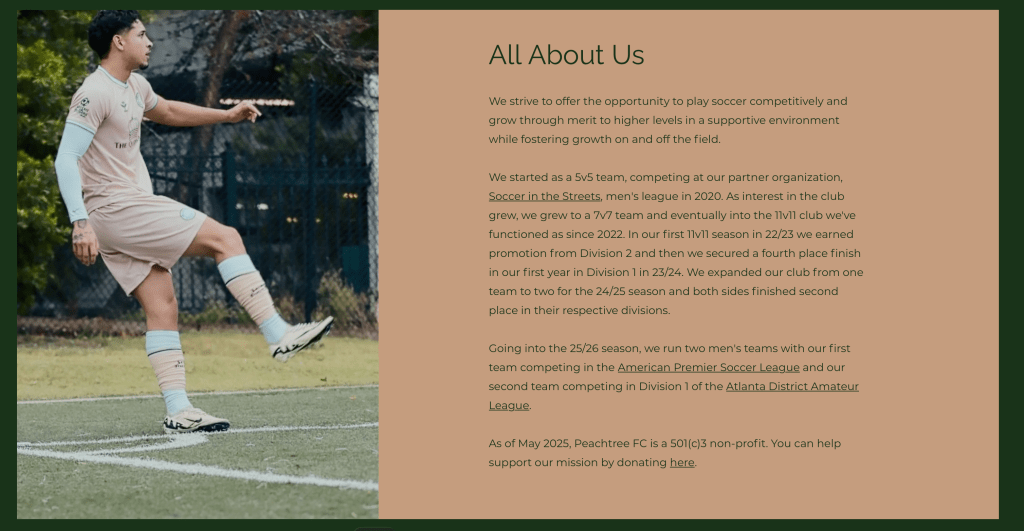
Q) You play what is classed as ‘Amateur’ level football with games on a Sunday and yet the whole look and approach to what you do and how you operate is very much like how an English Non-League club or better carry themselves, was there a real focus and desire to be professional with that side of things?
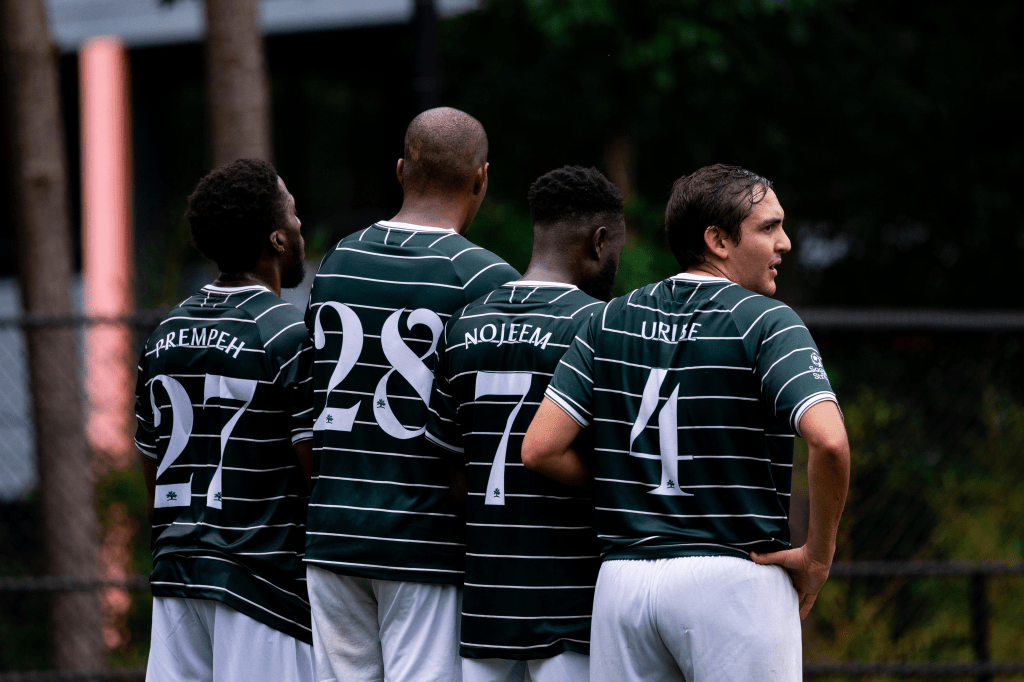
Having a professional approach to the club has been at the center of what we want to do since day 1. I took my own experience of wanting to get my money’s worth when paying to play and tried to apply that across every aspect of player interaction. We train once a week, host team events off the pitch, have custom designed corner flags, training wear, kits and captain armbands, as well as the most important aspect of being successful on the pitch.
Q) Your kits are designed by the incredible ‘Icarus’ brand – what drew you to them in particular and how easy was it to settle on what you wanted your kit to look like?
I was drawn to Icarus from my experience with New York International FC who used them when I was playing for the club. I knew the quality of the product was good and loved the ability to custom design the kits to make something that truly says Peachtree FC instead of being a template kit from a larger brand with the Peachtree logo added on. The design process was great although it did take some learning on our end to get to our current kits, for example we realized our black kits we wore in our first year weren’t ideal for playing in 100 F weather during the summer which led us to changing to our forest green.
Our current kits drew inspiration from Atlanta and Georgia which came together to make a truly great and unique product. Atlanta hosted the Olympics in 1996 and will be one of the World Cup host cities in 2026. Both logos have forest green in their design which goes hand in hand with Atlanta being known as the City in the Forest to help us land on the forest green colorway. Georgia is known as the Peach State and along with having Peach in our name, it made perfect sense to have the Peach away kit. Finally our cream kits were inspired by retro kits from the 90s and early 2000s to round out our current kits.
Q) You have a real strong social media presence and focus – was this always the plan and where have you seen the most success?
Going back to running as professionally as possible at an amateur level, social media is a big part of a professional club. We wanted our content to look as professional as possible (even though it’s done by me and a teammate instead of any kind of marketing group or marketing team). We post consistently about our matches and results, even when we don’t win, and feature content from our games so people who can’t attend can still see highlights from the games and stay up to date with how the two teams are doing. Our most success has come on Instagram where we consistently see close to 100,000 views every month on our posts.
Q) Running costs are around $35-40,000 and so player subs is still something that are necessary in order to sustain the life of the club for the future, is the plan to make this a thing of the past by trying to attract a financial sponsor to help cover those overheads?
The dream is that Peachtree FC can become a free-to-play club for our players. We currently try to be as affordable as possible, but even still there are players who understandably struggle to cover the player subs. We hope with our non-profit status and growing on social media and in the community that we will be able to attract businesses and individuals to sponsor and donate to the club and make our dream come true.
Q) Would you say the ability to offer free to play football is the number one objective of Peachtree?
Yes, that is our number one objective. I think there are other objectives that will help us reach that goal such as finalizing a permanent home ground and a training field partner which can help solidify sponsors in the local area, but the number one goal is making Peachtree free to play.
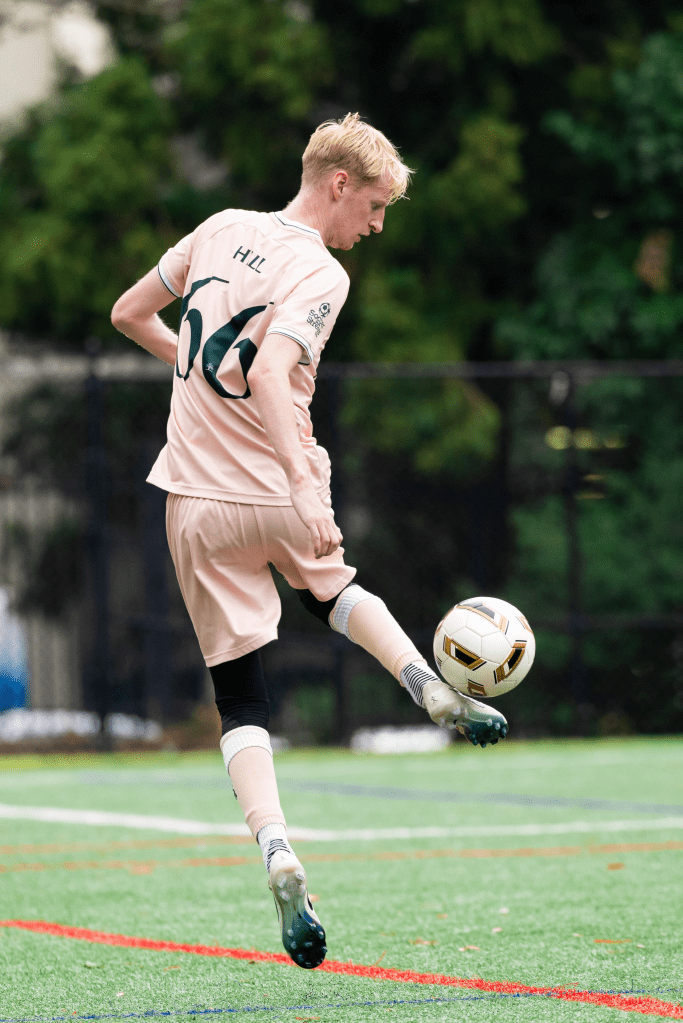
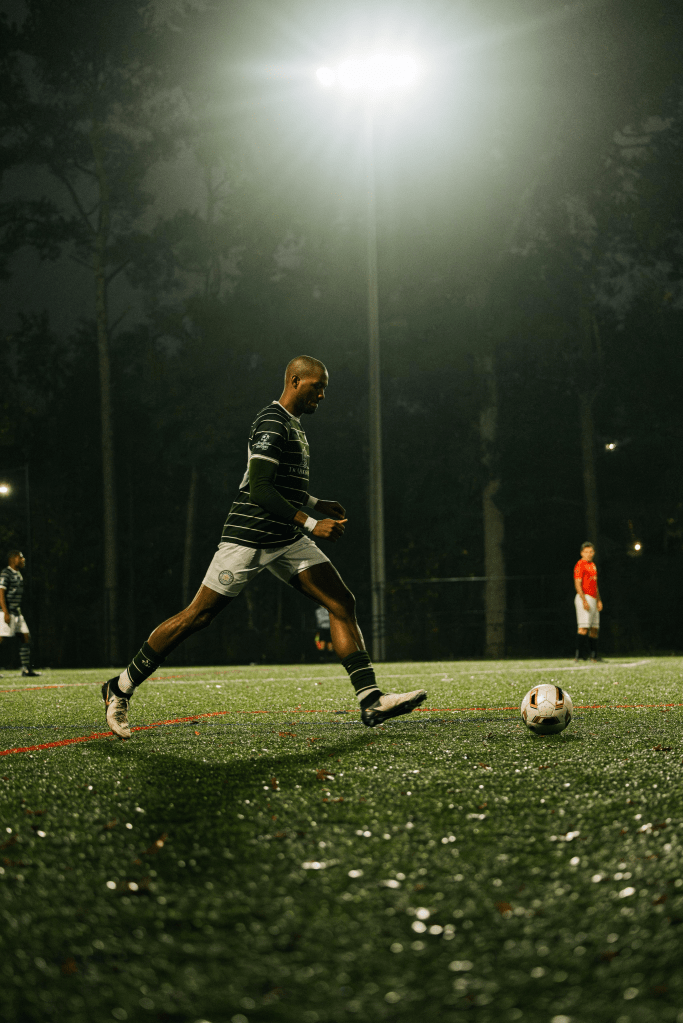
Q) With the World Cup coming to the US next year – what improvements to the grassroots level of the game and also the elite side of the game in the US would you like to see as the legacy left by the biggest tournament in the game coming to your shores?
I think the game will see more growth in fans and youth players which will ultimately benefit the grassroots and elite side of the game as more people attend games and the quality and depth of players grows. I’d love to see promotion and relegation added with a more connected pyramid that allows teams to organically grow and create more sustainability.
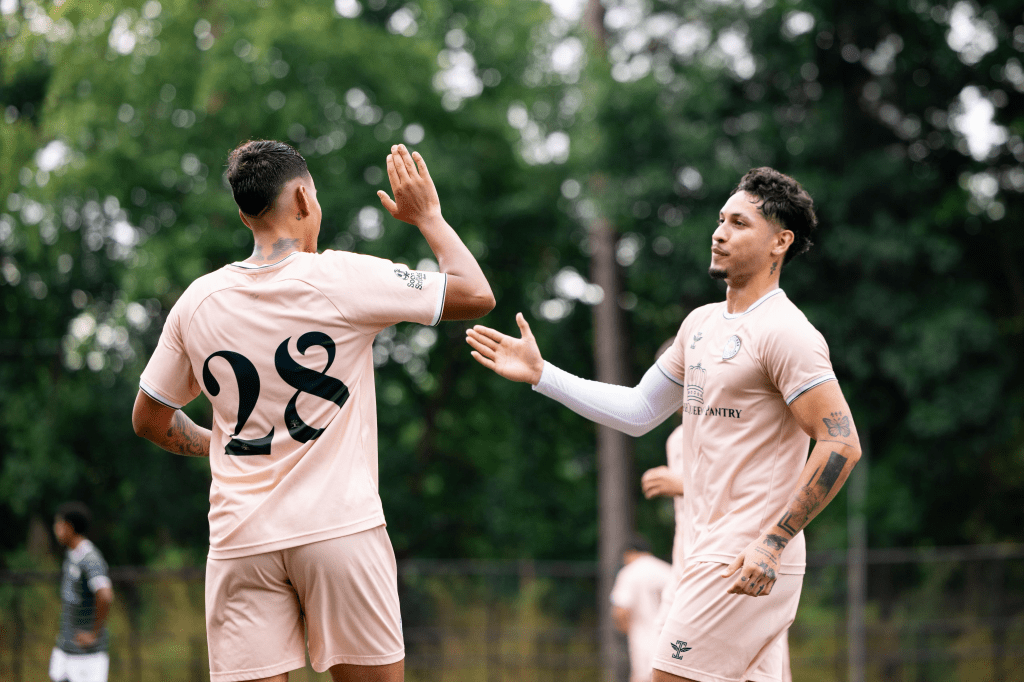
Q) In an ideal world, taking in the scale of the country, would you like to see as similar an approach to football as we have in the UK (relegation/promotion) or do you feel like the geography of the country restricts this?
I would like to see promotion/relegation in the US and I think it can be done with more levels. I know in the UK there are lower levels in the pyramid that are regionally split and I think that could be done to a higher level in the US with perhaps only the top division or two having no geographical restrictions.
Q) Why should someone come and follow your socials and maybe even come along for a game if they are in Atlanta next year?
We’re always growing and innovating on social media (a scroll through the page will see that growth from our first post to where we’re at now!) and looking to offer not only video of our games but also insights into the people who make the club what it is. We offer a high quality product on the pitch with both of our teams being very successful so far this year and we’re also a very welcoming group who are always appreciative to see fans in the stands and happy to spend time chatting after games and learning more about everyone who wants to spend a few hours of their Sunday with us.
A huge thank you to Jon for his time in sharing his journey getting Peachtree to where it is today and also for championing football in such a competitive marketplace. The club is something to be proud of and should I ever make it over to Atlanta I would 100% head to catch a game!
Should you be in the area for any of these games next year, I would highly recommend you to do the same.
Spain v Cabo Verde | Group H | Monday, 15 June
Czechia/Denmark/North Macedonia/Republic of Ireland v South Africa | Group A | Thursday, 18 June
Spain v Saudi Arabia | Group H | Sunday, 21 June
Morocco v Haiti | Group C | Wednesday, 24 June
Congo DR/Jamaica/New Caledonia v Uzbekistan | Group K | Saturday, 27 June
Match 80 | Round of 32 | Wednesday, 1 July
Match 95 | Round of 16 | Tuesday, 7 July
Match 102 | Semi-final | Wednesday, 15 July
The future of football in America might alot different from how it looks today and if that is to be the case, alot of it will be down to individuals such as Jon for spearheading change for the better.
Keep it up Jon – until next time everyone!
Parks to Pitches Magazine – Bringing you the best stories, interviews, and insights from the world of Non-league football, Parks to Pitches is your new go-to for everything Non-league!
Grab your copy right here: https://tttonlf.square.site/


 Through The Turnstile of Non-League Football
Leave a comment